
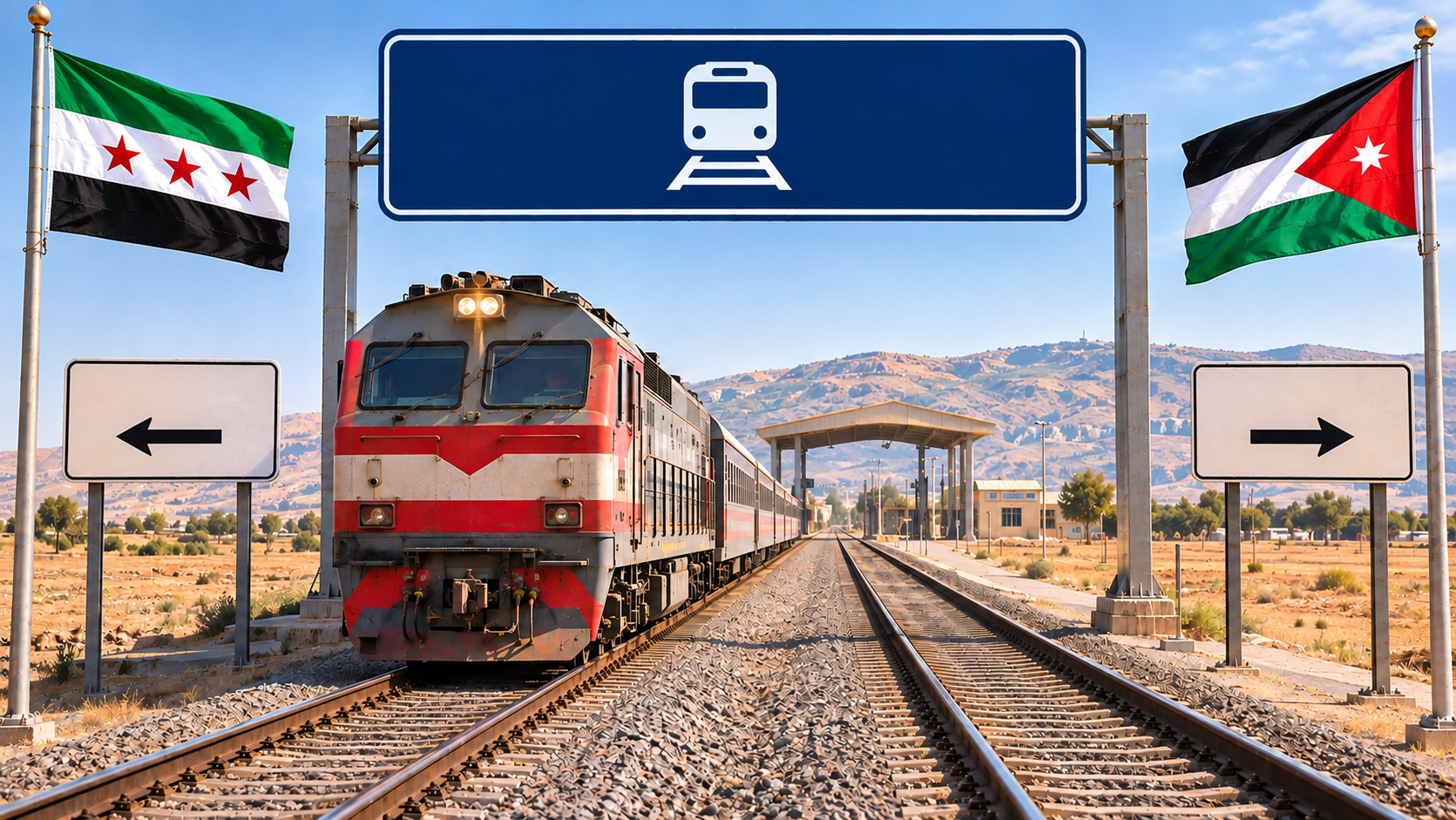
Syrian Foreign Minister Asaad Hassan al-Shaibani announced the agreement during a joint press conference with Jordanian Deputy Prime Minister and Foreign Minister Ayman Safadi at Tishreen Palace in Damascus, following the third session of the Syrian-Jordanian Higher Coordination Council.
Al-Shaibani described the railway connectivity memorandum as one of the most significant achievements of the meeting, emphasizing its potential to improve regional infrastructure, facilitate the movement of goods and passengers, and strengthen logistical cooperation between the two countries.
Eleven Cooperation Agreements Across Key Sectors
The coordination meeting resulted in the signing of 11 cooperation documents covering several strategic sectors, including cloud seeding in the Yarmouk River basin, food security, investment, civil aviation, academic exchanges and scholarships.
Officials reported that parallel discussions covered 19 sectors, culminating in bilateral meetings and an expanded ministerial session that finalized the agreements.
According to al-Shaibani, the total number of agreements and memoranda of understanding signed between Syria and Jordan has now reached 35, reflecting both countries' commitment to institutionalizing economic cooperation.
Bilateral Trade Triples to $330 Million
Economic relations between Damascus and Amman have recorded substantial growth, with bilateral trade nearly tripling over the past year to reach $330 million.
Officials expect the upward trend to continue, supported by new trade facilitation measures and improvements in cross-border infrastructure.
In the energy sector, al-Shaibani confirmed that natural gas has continued flowing to Syrian power stations through Jordanian territory since the beginning of the year.
The two countries have also activated a joint water-data platform and concluded a new agreement regulating air services between their national carriers.
Border Modernization and Infrastructure Investment
Both governments agreed on a comprehensive plan to modernize the Jaber-Nassib border crossing, transforming it into a model facility operating around the clock.
The project includes separate lanes for freight trucks and passengers to accelerate customs procedures and reduce congestion.
The two sides also agreed to introduce electronic customs connectivity and rehabilitate the international highway linking the countries, at an estimated cost of $47 million.
Discussions additionally addressed a proposal to establish a joint economic city along the Syrian-Jordanian border, designed to serve as an industrial and commercial hub.
Plans also include upgrading the shared free-trade zone and strengthening the Syrian-Jordanian Business Council to encourage private-sector investment.
Regional Energy Connectivity and Lebanon
Regional energy cooperation featured prominently in the discussions, with al-Shaibani reaffirming Syria's readiness to facilitate the transit of natural gas to Lebanon through Syrian territory.
The issue had previously been discussed in trilateral meetings involving Lebanese officials, as part of broader efforts to improve regional energy security and electricity supplies.
The ministers also explored opportunities to strengthen Jordan's food security through imports of surplus Syrian wheat and barley.
Additional initiatives included preparations to launch the Darb al-Safa telecommunications project and a training program for 1,450 Syrian public-sector employees in its second phase.
Toward Greater Regional Economic Integration
Jordanian Foreign Minister Ayman Safadi reaffirmed the longstanding historical ties between the Syrian and Jordanian peoples and reiterated Amman's commitment to supporting Syria in addressing its challenges.
He stressed that the agreements aim to promote economic integration and create opportunities for sustainable cooperation.
The proposed railway corridor represents a potentially significant step toward reconnecting regional transport networks, offering a future overland trade route stretching from Saudi Arabia through Jordan and Syria to Turkey.
If implemented, the project could strengthen cross-border commerce, reduce logistical barriers and position Syria and Jordan as key transit hubs connecting the Gulf with Turkey and wider regional markets.